

Rochester Real Estate · First-Time Buyers · Buyer EducationPre-Approval vs. Pre-Qualification: The Difference That Actually MattersPre-qualification and pre
Dated: September 11 2026
Views: 1
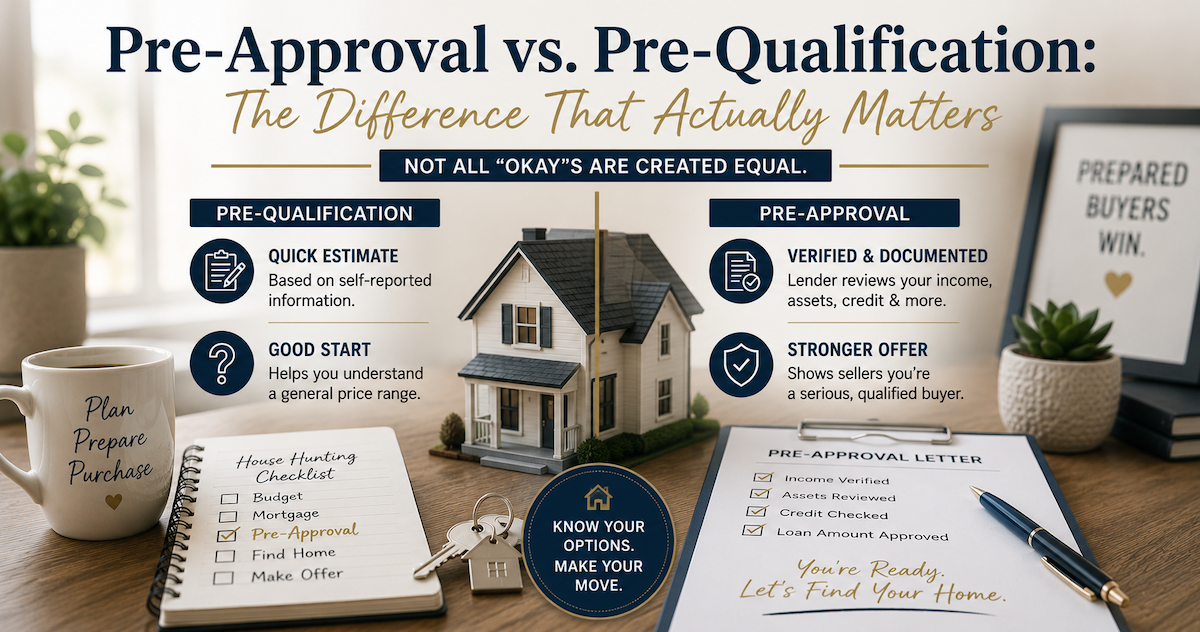
Pre-qualification and pre-approval sound similar, but they mean genuinely different things, and confusing them can cost you the house. Here's the difference that actually matters.
Pre-qualification and pre-approval sound similar, and real estate listings sometimes use the terms loosely, but they mean genuinely different things, and confusing them can cost a first-time buyer the house in a competitive offer. Here's the difference that actually matters, and why it's worth understanding before you start touring homes.
I'm Seana Caine, an Associate Real Estate Broker with RE/MAX Plus here in Rochester, and this mix-up comes up with first-time buyers more than almost any other term in the process.
Pre-qualification is typically a fast, informal process. You share basic financial information, your income, debts, and an estimate of your credit, with a lender, who runs a rough calculation of what you might be able to borrow. It usually takes minutes and often doesn't require documentation or a credit check.
Pre-approval is a more rigorous process. The lender verifies your income, employment, assets, and credit through documentation, pay stubs, tax returns, bank statements, and runs your information through actual underwriting guidelines. The result is a pre-approval letter stating a specific loan amount you're qualified to borrow, based on verified information rather than self-reported estimates.
| Pre-qualification | Pre-approval | |
|---|---|---|
| Based on | Self-reported information | Verified documentation |
| Typical time | Minutes | 1 to 3 days |
| Credit check | Often none or soft pull | Hard credit pull, typically |
| Strength with sellers | Weaker | Meaningfully stronger |
| Underwriting review | No | Yes, preliminary |
In a market where homes are moving quickly and receiving multiple offers, a pre-approval letter signals to a seller that your financing is further along and less likely to fall through. Sellers comparing two similar offers will often favor the one backed by pre-approval, even at an identical price, simply because it carries less risk of a financing delay or denial later in the process.
Starting your home search with only a pre-qualification can lead to a frustrating situation: falling in love with a home, writing an offer, and losing out to a buyer with stronger financing backing, or discovering during the actual pre-approval process that your real borrowing power is different than what the quick estimate suggested.
Yes, typically a small amount, since it usually involves a hard credit inquiry. This effect is generally minor and short-lived, and it's a normal, expected part of the home buying process. Multiple mortgage inquiries within a short window, typically 14 to 45 days depending on the credit scoring model, are usually counted as a single inquiry for scoring purposes, since credit models account for rate shopping.
Most pre-approval letters are valid for 60 to 90 days, after which your lender will typically need updated documentation to reissue it. If your home search takes longer than expected, plan to refresh your pre-approval rather than letting it lapse and assuming it's still valid.
Beyond simply making your offer look stronger on paper, pre-approval changes how confidently you can negotiate. Knowing your real, verified borrowing power means you can move quickly when the right home appears, without a financing question hanging over the offer. In multiple-offer situations, that speed and certainty is often what separates a winning offer from a similar one that loses out.
It also protects you from the disappointment of falling in love with a home only to learn later that your actual approved amount is lower than what a rough estimate suggested. Working from verified numbers from the start keeps your search grounded in homes you can genuinely afford.
Pre-approval tells you what you're qualified to borrow, but it doesn't typically lock in your interest rate. Rate locks usually happen later, once you're under contract on a specific property, and protect you from rate increases for a set window while your loan finishes processing. Don't assume your pre-approval rate is guaranteed all the way through closing, since market rates can move between pre-approval and when you actually lock.
Ask your lender specifically when rate locking happens in their process and how long a typical lock period lasts, so you understand which numbers are fixed and which are still subject to change as you search.
Understanding both pieces, your verified borrowing power and when your rate actually gets locked in, gives you a much clearer picture of your real budget throughout the search process, rather than a moving target that shifts every time market conditions change.
Getting this right at the start saves time and disappointment later. A pre-approval in hand, paired with a clear understanding of what happens next with your rate, means you're ready to move confidently the moment the right home comes along, rather than scrambling to catch up once a good listing appears.
When two people are applying together, whether spouses, partners, or family members, both sets of income, debt, and credit typically factor into the pre-approval, and both parties usually need to provide the same documentation individually. A significant credit score gap between co-borrowers can affect the loan terms you're offered, since lenders often use the lower of the two scores, or a blended calculation depending on the loan program.
If you're applying with someone else, have this conversation with your lender early, including how each person's specific financial picture affects the overall approval, rather than assuming your combined income alone tells the full story.
What's the actual difference between pre-qualification and pre-approval?
Pre-qualification is a quick, informal estimate based on self-reported information. Pre-approval involves a lender verifying your income, assets, and credit through actual documentation, resulting in a specific, more reliable loan amount.
Which one should I get before house hunting?
Pre-approval. It gives you a reliable budget and signals to sellers that your financing is further along, which matters in a competitive market where multiple offers are common.
Does getting pre-approved hurt my credit score?
It typically causes a small, short-term dip due to a hard credit inquiry, which is a normal part of the process. Multiple mortgage inquiries within a short window are usually treated as a single inquiry by credit scoring models.
How long is a pre-approval letter valid?
Most pre-approval letters are valid for 60 to 90 days. If your search takes longer, you'll likely need to provide updated documentation to refresh it.
Can my pre-approved loan amount change later?
Yes, if your financial situation changes, such as taking on new debt, a job change, or a credit score shift, your final approved amount at closing could differ from your initial pre-approval.
I can connect you with lenders who work with first-time buyers regularly, so you walk into your search with real numbers in hand. Ready to take the next step? I'd love to help you get there.

Rochester Real Estate · First-Time Buyers · Buyer EducationPre-Approval vs. Pre-Qualification: The Difference That Actually MattersPre-qualification and pre
Rochester Real Estate · Local Rochester Info · Neighborhood GuideGetting to Know Rochester's Neighborhoods: A Closer Look at 7 AreasRochester is made up of
Rochester Real Estate · General Real Estate · Pricing GuideWhat a CMA Actually Tells You (And What It Doesn't)A CMA tells you what similar homes have actually
Rochester Real Estate · Relocation Guide · Renting vs BuyingRenting vs. Buying in Your First Year in Rochester: The Real MathWhether renting or buying costs
 The Greater Syracuse Association of REALTORS ®: The data relating to real estate on this web site comes in part from the Internet Data Exchange (IDX) Program of the CNYIS, powered by CNYIS. Real estate listings held by firms other than REMAX Plus, are marked with the IDX logo and detailed information about them includes the Listing Broker's Firm Name. All information deemed reliable but not guaranteed and should be independently verified. All properties are subject to prior sale, change or withdrawal.
Neither the listing broker(s) nor this site's owner shall be responsible for any typographical errors, misinformation, misprints, and shall be held totally harmless.
© Central New York Information Service, Inc. All rights reserved.
Show More...
The Greater Syracuse Association of REALTORS ®: The data relating to real estate on this web site comes in part from the Internet Data Exchange (IDX) Program of the CNYIS, powered by CNYIS. Real estate listings held by firms other than REMAX Plus, are marked with the IDX logo and detailed information about them includes the Listing Broker's Firm Name. All information deemed reliable but not guaranteed and should be independently verified. All properties are subject to prior sale, change or withdrawal.
Neither the listing broker(s) nor this site's owner shall be responsible for any typographical errors, misinformation, misprints, and shall be held totally harmless.
© Central New York Information Service, Inc. All rights reserved.
Show More...
 The data relating to real estate on this web site comes in part from the Internet Data Exchange (IDX) Program of NYSAMLS. Real estate listings held by firms other than REMAX Plus, are marked with the IDX logo and detailed information about them includes the Listing Brokers Firm Name.
Disclaimer: All information deemed reliable but not guaranteed and should be independently verified. All properties are subject to prior sale, change or withdrawal. Neither the listing broker(s) nor REMAX Plus shall
be responsible for any typographical errors, misinformation, misprints, and shall be held totally harmless. © 2026 CNYIS, GENRIS, WNYREIS. All rights reserved.
Show More...
The data relating to real estate on this web site comes in part from the Internet Data Exchange (IDX) Program of NYSAMLS. Real estate listings held by firms other than REMAX Plus, are marked with the IDX logo and detailed information about them includes the Listing Brokers Firm Name.
Disclaimer: All information deemed reliable but not guaranteed and should be independently verified. All properties are subject to prior sale, change or withdrawal. Neither the listing broker(s) nor REMAX Plus shall
be responsible for any typographical errors, misinformation, misprints, and shall be held totally harmless. © 2026 CNYIS, GENRIS, WNYREIS. All rights reserved.
Show More...
