

Rochester Real Estate · Relocation Guide · Moving Tips5 Mistakes Rochester Sellers Make When Moving SouthA two-state move has more moving parts than a typical

Dated: September 16 2026
Views: 5
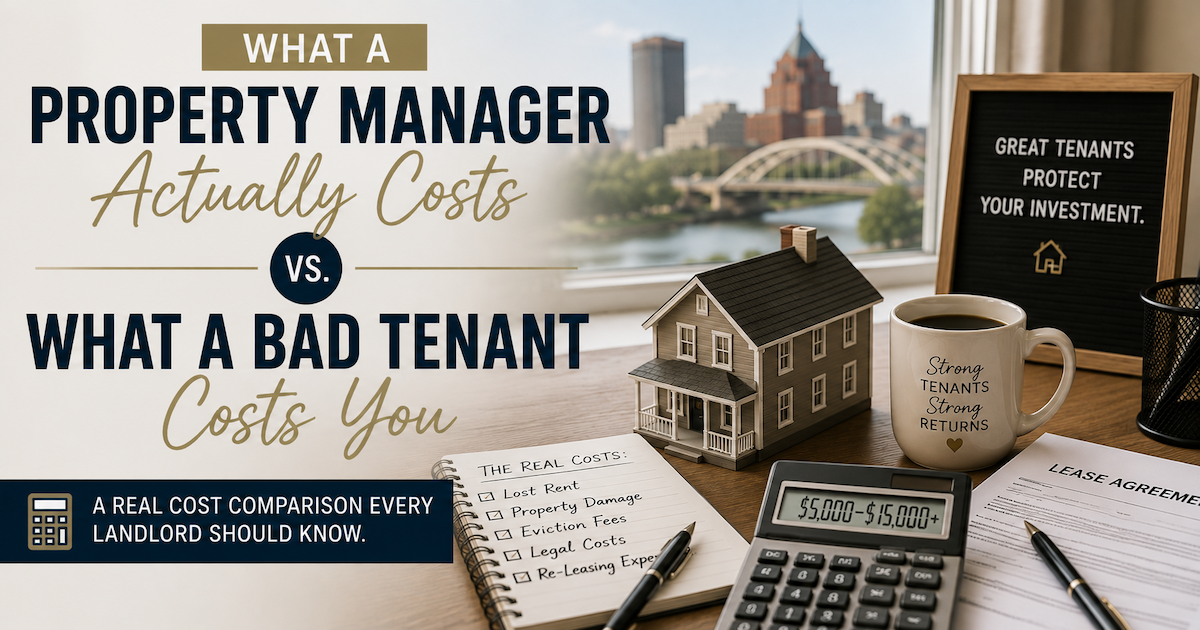
A property manager costs a percentage of your rent every month. A bad tenant can cost thousands in a single incident. Here's how the real numbers compare.
A property manager typically costs 8% to 12% of monthly rent, which on a $1,500-a-month Rochester rental works out to $120 to $180 a month, or roughly $1,440 to $2,160 a year. A single bad tenant, factoring in unpaid rent, damage, and eviction costs, can easily cost $5,000 to $15,000 or more. Here's how the real numbers compare, and when paying for management actually pays for itself.
I'm Seana Caine, an Associate Real Estate Broker with RE/MAX Plus, and this is one of the more common cost-benefit questions I hear from out-of-state landlords deciding how hands-on to be with a Rochester rental.
On a $1,500-a-month rental, a full-service property manager might cost $1,800 to $2,700 a year once the management fee, an occasional leasing fee, and any maintenance coordination charges are added up. That's the baseline cost of buying distance and convenience.
A genuinely bad tenant situation, one involving significant unpaid rent, property damage, or an eviction, is considerably more expensive than most landlords expect going in.
The real value of a property manager, or of doing thorough screening yourself, isn't the day-to-day rent collection, it's reducing the odds of the expensive scenario above in the first place. Professional screening services check credit history, eviction records, income verification, and rental history, applying consistent criteria to every applicant to stay compliant with fair housing law.
A property manager with an established local process for this tends to catch red flags that a landlord managing occasionally and remotely might miss, simply because screening well takes consistent practice and access to the right verification tools.
Self-managing isn't automatically the riskier choice. Landlords who have reliable local contacts for maintenance, use a solid screening service themselves, and have the time and temperament to handle tenant communication can manage successfully without a property manager's fee eating into their margins.
The math tends to favor self-managing more clearly on a single well-performing property with a reliable, long-term tenant already in place. It tends to favor hiring a manager more clearly for landlords with multiple properties, unpredictable travel schedules, or a track record of tenant issues that consistent professional screening could have caught.
A property manager who can't answer these clearly, or whose fee structure is vague until after you sign, is worth reconsidering. The best property managers are upfront about total costs and have a specific, repeatable process for screening, not just a general assurance that they're thorough.
Rochester's relatively steady rental demand, compared to more volatile markets, generally supports a healthy pool of qualified applicants, which makes thorough screening more valuable rather than less. With a reasonable number of applicants to choose from, the cost of screening well is small relative to the benefit of selecting a reliable, long-term tenant over a rushed choice made simply to fill a vacancy quickly.
This is worth keeping in mind whether you hire a manager or self-manage: the goal isn't filling the vacancy as fast as possible, it's filling it with the right tenant, since the cost difference between a good and bad outcome dwarfs the time saved by rushing the decision.
Regardless of whether you hire a property manager or self-manage, confirm your landlord insurance policy is current and actually covers the property as a rental, not just as a primary residence. A standard homeowners policy typically doesn't extend to a rented property, and finding this out after a claim is denied is a far more expensive lesson than the cost of the correct policy from the start.
If self-managing, it's also worth having a real estate attorney review your lease template periodically, since landlord-tenant law can change, and a lease that was solid several years ago may no longer reflect current requirements.
Whichever path you choose, the underlying goal is the same: reduce the odds of the expensive scenario, not just minimize the monthly fee. A cheaper approach that increases your risk of a costly tenant situation isn't actually the lower-cost option once the full picture is considered.
Run your own numbers based on your specific rent amount, your available time, and your comfort level with remote management before deciding either way, rather than defaulting to whichever option feels more familiar from a past experience. The right answer depends on your specific situation, not a general rule that applies to every landlord equally.
The math shifts further toward professional management as your portfolio grows. Screening, showing, and coordinating maintenance across multiple properties from a distance takes considerably more time than managing one, and the cost of a bad tenant multiplies with each additional unit you're responsible for. Many owners who successfully self-manage a single rental find that a second or third property is where hiring a manager starts to make clear financial sense, simply due to the added time commitment involved.
How much does a property manager typically cost?
Property managers commonly charge 8% to 12% of monthly rent, plus a separate leasing fee, often one month's rent, to place a new tenant.
How much can a bad tenant actually cost a landlord?
Factoring in lost rent during an eviction process, legal costs, property damage, and re-leasing expenses, a single bad tenant situation commonly runs $5,000 to $15,000 or more.
Does a property manager guarantee I won't get a bad tenant?
No, but thorough, consistent screening significantly reduces the odds. Professional screening services check credit, eviction history, and income verification more consistently than many self-managing landlords do on their own.
Is self-managing riskier than hiring a property manager?
Not necessarily, if you have reliable local contacts, use solid screening tools, and have the time to handle communication and maintenance coordination. It becomes riskier mainly when those resources aren't in place.
Is there a middle ground between full property management and self-managing?
Yes. Some property managers offer tenant placement only, handling marketing and screening for a one-time fee while the owner self-manages afterward, capturing much of the screening benefit without the ongoing monthly cost.
I can help you think through the real numbers for your specific property. Ready to take the next step? I'd love to help you get there.

Rochester Real Estate · Relocation Guide · Moving Tips5 Mistakes Rochester Sellers Make When Moving SouthA two-state move has more moving parts than a typical
Rochester Real Estate · Landlord Guide · Property ManagementWhat a Property Manager Actually Costs vs. What a Bad Tenant Costs YouA property manager costs a
Rochester Real Estate · Rightsizing · Home CostsThe Hidden Cost of Staying Too Long in a House That's Too BigStaying in a home that's grown too large isn't.
Rochester Real Estate · First-Time Buyers · Buyer EducationPre-Approval vs. Pre-Qualification: The Difference That Actually MattersPre-qualification and pre
 The Greater Syracuse Association of REALTORS ®: The data relating to real estate on this web site comes in part from the Internet Data Exchange (IDX) Program of the CNYIS, powered by CNYIS. Real estate listings held by firms other than REMAX Plus, are marked with the IDX logo and detailed information about them includes the Listing Broker's Firm Name. All information deemed reliable but not guaranteed and should be independently verified. All properties are subject to prior sale, change or withdrawal.
Neither the listing broker(s) nor this site's owner shall be responsible for any typographical errors, misinformation, misprints, and shall be held totally harmless.
© Central New York Information Service, Inc. All rights reserved.
Show More...
The Greater Syracuse Association of REALTORS ®: The data relating to real estate on this web site comes in part from the Internet Data Exchange (IDX) Program of the CNYIS, powered by CNYIS. Real estate listings held by firms other than REMAX Plus, are marked with the IDX logo and detailed information about them includes the Listing Broker's Firm Name. All information deemed reliable but not guaranteed and should be independently verified. All properties are subject to prior sale, change or withdrawal.
Neither the listing broker(s) nor this site's owner shall be responsible for any typographical errors, misinformation, misprints, and shall be held totally harmless.
© Central New York Information Service, Inc. All rights reserved.
Show More...
 The data relating to real estate on this web site comes in part from the Internet Data Exchange (IDX) Program of NYSAMLS. Real estate listings held by firms other than REMAX Plus, are marked with the IDX logo and detailed information about them includes the Listing Brokers Firm Name.
Disclaimer: All information deemed reliable but not guaranteed and should be independently verified. All properties are subject to prior sale, change or withdrawal. Neither the listing broker(s) nor REMAX Plus shall
be responsible for any typographical errors, misinformation, misprints, and shall be held totally harmless. © 2026 CNYIS, GENRIS, WNYREIS. All rights reserved.
Show More...
The data relating to real estate on this web site comes in part from the Internet Data Exchange (IDX) Program of NYSAMLS. Real estate listings held by firms other than REMAX Plus, are marked with the IDX logo and detailed information about them includes the Listing Brokers Firm Name.
Disclaimer: All information deemed reliable but not guaranteed and should be independently verified. All properties are subject to prior sale, change or withdrawal. Neither the listing broker(s) nor REMAX Plus shall
be responsible for any typographical errors, misinformation, misprints, and shall be held totally harmless. © 2026 CNYIS, GENRIS, WNYREIS. All rights reserved.
Show More...
